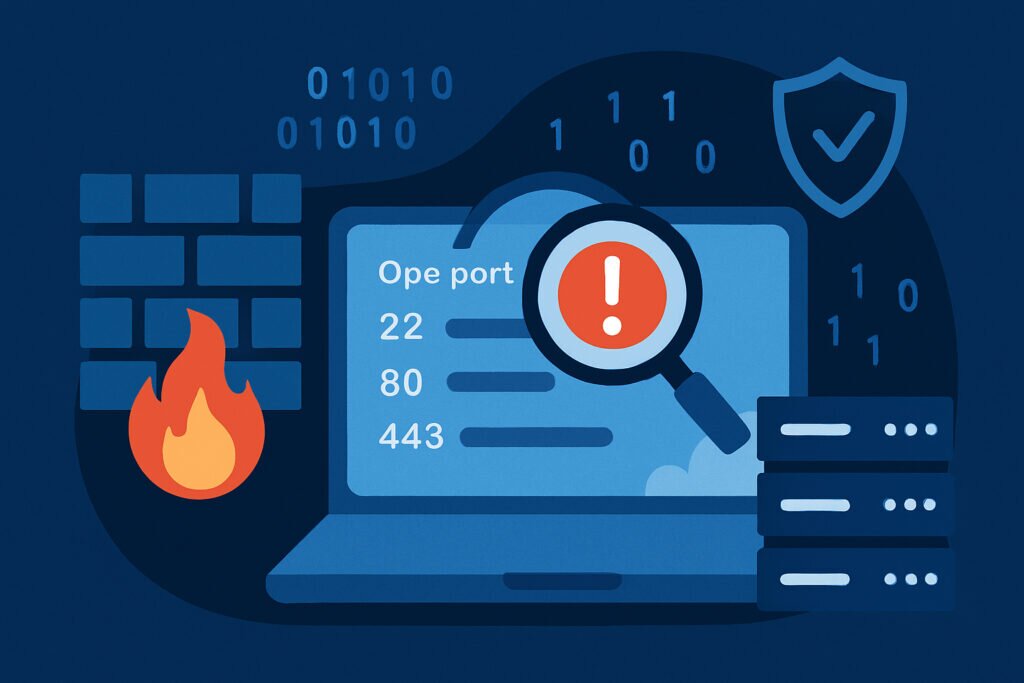
Firewall rules are one of the most trusted tools in network security – but there’s a real and persistent gap between what your firewall policy says and what’s actually exposed on your servers. Understanding the port monitoring gap means recognizing that firewalls and port monitoring solve different problems, and relying on one while ignoring the other leaves meaningful risk on the table.
What Firewalls Actually Do – and What They Don’t
A firewall enforces access control based on rules you define. Traffic matching a rule is allowed or blocked. That’s it.
What firewalls don’t do is tell you what services are actually listening on the other side of those rules. A firewall can be configured perfectly and still permit access to a vulnerable, outdated application simply because the rule was written to allow traffic on that port – perhaps years ago, for a different purpose.
Firewall rules also tend to accumulate. Rules get added when projects launch and rarely get cleaned up when those projects end. Over time, the ruleset drifts away from reality.
The Gap Between Policy and Reality
This is where the port monitoring gap becomes concrete. Consider a scenario: a developer spins up a test instance on a production server, binds a service to port 8080, and forgets about it. The firewall has a broad rule permitting outbound traffic on high-numbered ports. From the inside, everything looks fine – no policy was violated. From the outside, an attacker’s scanner picks it up in seconds.
The firewall never “caught” this because it wasn’t designed to. It was doing its job. The problem is that no one was watching what opened up on the server itself.
This is exactly the kind of exposure that shadow IT creates – services appearing on the network without going through any formal approval or review process.
Why Internal Checks Aren’t Enough Either
A common response to this concern is: “We run `netstat` regularly” or “Our monitoring agent checks listening ports.” That’s better than nothing, but it misses something important.
Internal visibility tells you what the server sees. It doesn’t tell you what the internet sees.
External port scans reveal the attacker’s perspective – what ports are reachable from outside your network, which services respond, and what version information those services expose. NAT, load balancers, reverse proxies, and cloud security groups all affect what’s externally visible in ways that internal checks simply can’t replicate.
A service might be listening on the server but blocked by a cloud security group – or the opposite: a port might appear closed internally but be reachable externally due to a misconfigured NAT rule. Only an external scan resolves that ambiguity.
Myth: “My Firewall Logs Would Show Any Unauthorized Access”
This is one of the most persistent misconceptions in network security. Firewall logs show you traffic that was attempted and blocked, and traffic that was allowed. They don’t show you that an exposed service exists – only that someone tried to reach it (if it was blocked) or that they succeeded (if it wasn’t).
By the time firewall logs reveal a problem, the exposure already existed. An attacker doing quiet reconnaissance on an exposed port may not generate any meaningful log entries at all, especially if the firewall rule permits that traffic.
The logs are a forensic tool. Port monitoring is a preventive one.
Real-World Consequences of the Gap
The typical breach scenario that exploits this gap isn’t sophisticated. An application gets deployed with a debug interface open on a non-standard port. No firewall rule explicitly blocks it. The service runs an outdated version with a known CVE. An automated scanner finds it within hours or days. Exploitation follows.
This pattern repeats across industries. The attacker didn’t bypass the firewall – the firewall was never asked to block that port. The gap wasn’t in the firewall; it was in the visibility layer.
Some of the most damaging exposures come from services that have been running for months with no one aware they’re internet-facing. Databases, admin panels, remote management interfaces – all reachable, all forgotten.
Closing the Gap With Continuous Port Monitoring
Firewall rules need a complement: ongoing, external visibility into what’s actually open and what’s listening on each port. The goal is to detect changes as they happen, not discover exposures during an annual audit or after an incident.
Setting up alerts for new open ports is a practical starting point. When a port appears that wasn’t there yesterday, you want to know before an attacker does. That alert gives you the opportunity to investigate, confirm whether it’s intentional, and close it if it isn’t.
Effective port monitoring should also include service detection – knowing not just that port 5432 is open, but that it’s running PostgreSQL 12.3, which has specific vulnerabilities that need attention. Version-level visibility transforms a list of open ports into actionable risk data.
Building a Layered Approach
The right framing isn’t “port monitoring vs. firewalls.” Both are necessary. Firewall rules control access; port monitoring verifies reality. Together they cover what neither can do alone.
Practically, that means:
– Maintaining firewall rules and reviewing them periodically for relevance
– Running continuous external port scans against all public-facing IPs
– Mapping every detected open port to a documented, justified business reason
– Alerting on any new port that appears outside of a change management process
– Correlating service versions against CVE databases to catch vulnerable software
None of these steps is complicated individually. The gap appears when organizations treat firewall configuration as a finished product rather than a living part of a broader security posture.
FAQ
Can a correctly configured firewall still leave ports exposed?
Yes. A firewall enforces the rules it’s given. If a rule permits traffic on a port – even one that was added years ago for a temporary purpose – the firewall will allow it. The firewall has no way to judge whether the service currently listening on that port should be publicly accessible.
How is port monitoring different from a vulnerability scanner?
Port monitoring continuously tracks which ports are open and what services are responding on each. Vulnerability scanning goes deeper into application-layer weaknesses but is typically run less frequently. Port monitoring gives you persistent, real-time visibility into your attack surface; vulnerability scanning gives you depth at a point in time. Both serve different functions in a security program.
How quickly can an exposed port be found by attackers?
Mass internet scanners – operated by researchers, threat actors, and botnets alike – cover the entire IPv4 address space in under an hour. A new open port on a public IP can realistically be indexed within minutes to a few hours. The assumption that an obscure port on a high number will stay hidden is not a reliable security control.
Summary
Firewalls are essential, but they can only enforce what they’ve been told to enforce. The port monitoring gap is the space between your firewall policy and the actual exposed surface of your servers – and it’s wider than most organizations realize. Closing that gap requires external, continuous visibility: knowing exactly which ports are open, what’s listening on them, and whether those services carry known vulnerabilities. That combination – firewall rules plus ongoing port monitoring – is what a complete perimeter security posture actually looks like.