If you manage a server that faces the public internet, you already know the feeling. You check your auth logs and see thousands of brute-force attempts against SSH, random bots probing every open port, and automated scanners looking for anything they can exploit. It never stops. So naturally, you start looking for ways to hide your services from all that noise, and sooner or later you stumble across port knocking.
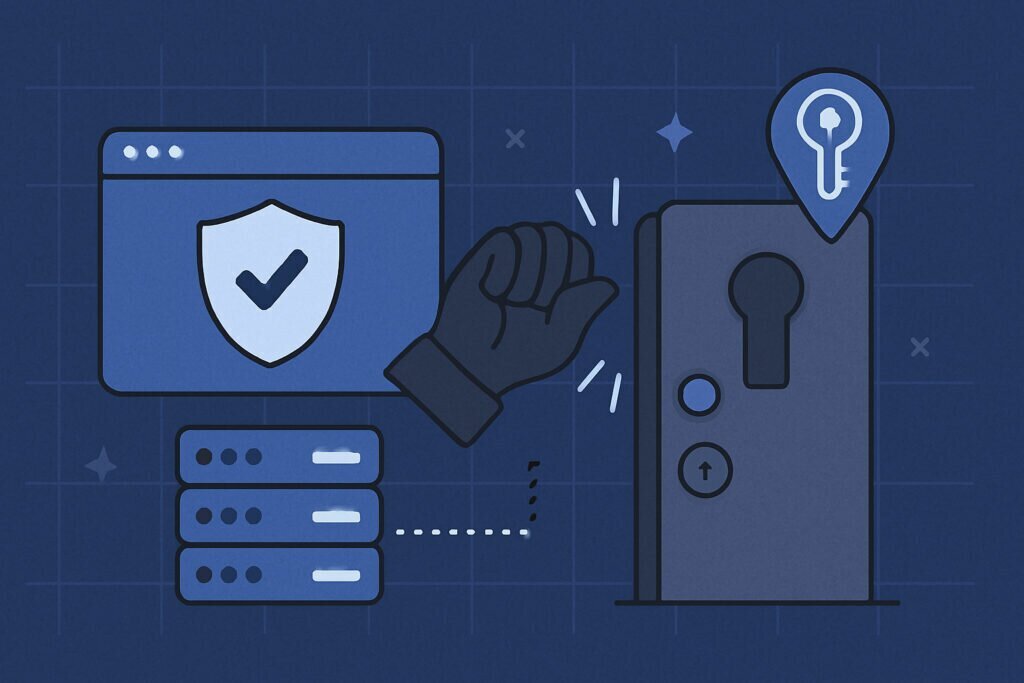
The idea sounds almost too clever: keep your ports completely closed and invisible until a client sends a secret sequence of connection attempts to specific ports in the right order. Only then does the firewall open up the real service port, and only for that specific IP. It is like a secret handshake before the door opens.
But does it actually improve security in a meaningful way, or is it just security through obscurity dressed up in a clever disguise? Let me break this down based on real-world experience.
How Port Knocking Works in Practice
The basic mechanism is straightforward. You configure a daemon like knockd on your server that monitors firewall logs for incoming connection attempts. You define a sequence, say TCP ports 7000, 8500, 9100, that must be hit in the correct order within a specific time window. When the sequence matches, knockd executes an iptables or nftables command that opens the target port, typically SSH on port 22, for the source IP address. After a timeout or a closing knock sequence, the rule gets removed and the port disappears again.
On the client side, you run a simple knock command before connecting. Something like knock myserver.com 7000 8500 9100 followed by your normal SSH connection. Some people script this into a single alias so it feels seamless.
I set this up on a Debian server a few years back that was getting hammered with SSH brute-force attempts. The setup itself took maybe twenty minutes. Install knockd from the repository, edit /etc/knockd.conf with your chosen sequence, make sure the default iptables policy drops connections to port 22, and start the service. The effect was immediate. My auth log went from thousands of failed login attempts per day to essentially zero. The silence was almost unsettling.
The Real Security Benefits
Port knocking does provide genuine advantages, but you need to understand exactly what those advantages are.
First, it dramatically reduces your attack surface visibility. Automated scanners and bots rely on finding open ports. If port 22 does not respond at all, your server simply does not exist to most attackers. This eliminates the vast majority of opportunistic attacks, which account for the bulk of what most servers face daily.
Second, it adds a layer of authentication before the service layer. An attacker would need to know that port knocking is in use, know the exact sequence, know the correct protocol for each knock, and know the timing window. Only then would they even reach your SSH login prompt where normal authentication takes over.
Third, it protects against zero-day vulnerabilities in the hidden service. If a critical SSH vulnerability is announced tomorrow morning, your server is not immediately exploitable because attackers cannot even reach the SSH daemon to try the exploit. That buys you valuable time to patch.
Where Port Knocking Falls Short
Now here is where we need to be honest, because port knocking is not a silver bullet and pretending otherwise would be irresponsible.
The knock sequence is sent in cleartext. Anyone who can observe your network traffic, through a man-in-the-middle position or packet capture, can see the exact sequence and replay it. This is a real concern on untrusted networks. There is an improved variant called Single Packet Authorization, or SPA, implemented by tools like fwknop, which solves this by sending an encrypted and cryptographically signed packet instead of a simple sequence. If you are serious about this approach, SPA is the way to go.
Port knocking also adds complexity. If knockd crashes or your firewall rules get flushed during an update, you might lock yourself out of your own server. I learned this the hard way once after a routine reboot where knockd did not start automatically. I had to use an out-of-band console to get back in. Always make sure you have a backup access method like a hosting provider console or IPMI.
It can also be inconvenient when you need quick access from a new device or location. If you are troubleshooting a production issue at two in the morning from your phone, fumbling with knock sequences is not ideal.
Port Knocking vs. Other Approaches
How does port knocking compare to alternatives? Using SSH key-based authentication with password login disabled is arguably more important than port knocking and should be your baseline regardless. A VPN like WireGuard can achieve the same hiding effect while also encrypting your traffic. Fail2ban is simpler to set up and handles brute-force attacks effectively, though it still leaves your port visible to scanners.
The best approach is usually a combination. Use key-based authentication as your foundation, add fail2ban for rate limiting, and consider port knocking or SPA as an additional layer if your threat model justifies it.
Should You Actually Use It?
Port knocking is not just security through obscurity, though that is a common criticism. It is an additional authentication layer on top of your existing security. The key word is additional. It should never be your only protection.
For personal servers and small business setups, port knocking with knockd is a practical and effective way to reduce noise and add protection. For anything handling sensitive data or facing sophisticated threats, upgrade to SPA with fwknop instead.
Either way, none of this replaces the fundamentals. Keep your software patched, use strong authentication, minimize the services you expose, and regularly audit what is actually open on your server. Tools like PortVigil can give you continuous external visibility into your open ports so nothing slips through unnoticed, which is exactly the kind of ongoing awareness that complements techniques like port knocking.
Common Questions
Can port knocking be detected? Yes, with enough traffic analysis, but it is impractical for most attackers. SPA is much harder to detect.
Does it work with UDP services? Yes, the knock sequence can use TCP, UDP, or a mix of both. The protected service behind it can be anything.
What if I forget the sequence? Keep it documented securely. And always maintain an alternative access method to your server.
Is it worth the effort? If you are already running SSH with key authentication and fail2ban, port knocking adds moderate value for minimal effort. If you are still using password authentication, fix that first.
Port knocking is a useful tool in the right context. Just do not let it give you a false sense of invincibility. Real security is always about layers, and every layer matters.