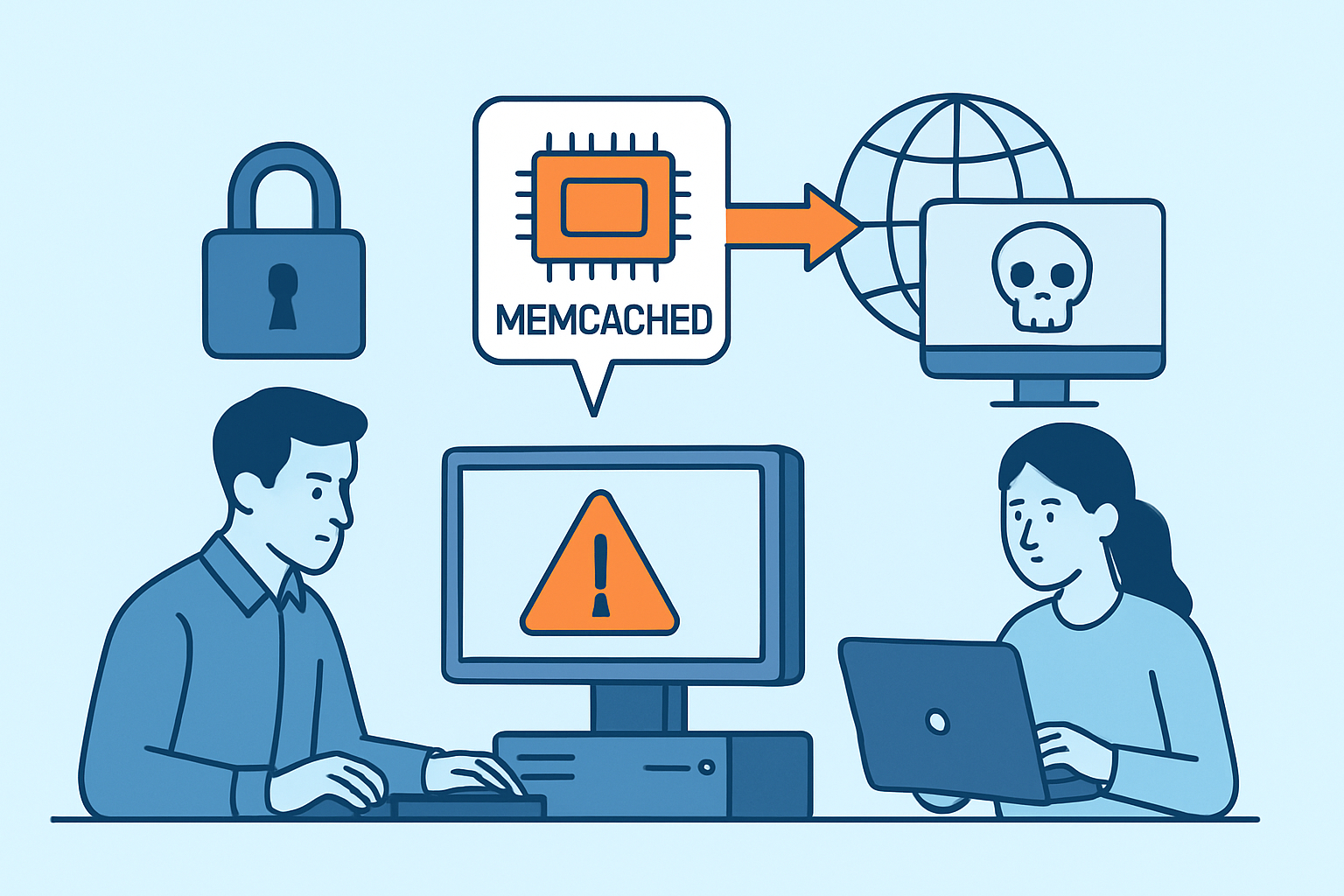
Memcached was never designed to sit exposed on the public internet, yet thousands of instances still answer UDP queries from anyone who asks – and that single misconfiguration turns a caching layer into one of the most efficient DDoS amplification vectors available today. Memcached exposure and amplification attack risk became a mainstream concern after the February 2018 GitHub incident, when attackers used exposed Memcached servers to generate a 1.35 Tbps flood, and the record didn’t last long – Arbor Networks measured a 1.7 Tbps attack against a US service provider just days later.
Why Memcached Amplification Works So Well
Memcached listens on port 11211 by default, over both TCP and UDP. The UDP protocol is the problem. It’s connectionless and doesn’t verify the source address, so an attacker can spoof the victim’s IP in a request packet and the Memcached server will dutifully send its response to that forged address instead.
The amplification factor is what makes this so dangerous. A small request – a few dozen bytes asking the server to return cached data – can trigger a response tens of thousands of times larger if an attacker has first primed the cache with large values. Cloudflare documented amplification factors as high as 51,000x during the 2018 wave, dwarfing DNS amplification (50-100x) and NTP amplification (up to 556x). A botnet with modest bandwidth can turn a handful of exposed Memcached instances into a multi-terabit weapon pointed at someone else entirely.
How Servers End Up Exposed in the First Place
Nobody sets out to expose Memcached to the internet. It happens through a handful of predictable paths.
Cloud deployments are the most common source. A developer spins up an EC2 or DigitalOcean instance, installs Memcached for a caching layer, and leaves the default security group or firewall rule wide open because the app “just needs to talk to the cache.” On a single-host deployment where the app and cache sit on the same box, there’s rarely a reason for port 11211 to be reachable from outside at all – but default configs on distros like Ubuntu historically bound Memcached to 0.0.0.0 rather than 127.0.0.1, so unless someone deliberately restricted it, it’s listening on every interface.
Docker adds its own trap. Running docker run -p 11211:11211 publishes the port to all host interfaces by mapping it through iptables NAT rules, which bypass UFW and most host firewall tooling entirely – a mistake covered in more depth in our piece on Docker container port exposure. A container that looks firewalled at the OS level can still be wide open because the firewall never sees the traffic.
Shared hosting environments and forgotten dev/staging servers round out the list. A staging box spun up for a load test, with Memcached installed and never torn down, is exactly the kind of asset that shows up in Shodan scans two years later still answering stats requests from strangers.
Confirming Whether Your Memcached Instance Is Reachable
An experienced practitioner doesn’t assume a firewall rule is doing its job – they verify from outside the network, since internal checks miss NAT and cloud security group misconfigurations that only manifest externally. From a machine outside your network, run:
echo -e “statsrn” | nc -u -w2 YOUR_SERVER_IP 11211
If the server responds with a block of stats output – uptime, curr_items, bytes, connection counts – it’s reachable and answering unauthenticated queries. That’s the same information disclosure and amplification surface attackers scan for. A response also confirms UDP is enabled, which for most production Memcached deployments is unnecessary; the UDP protocol was added mainly for specific replication and multicast use cases that the vast majority of deployments never touch.
Fixing Memcached Exposure
The remediation steps are straightforward, but each addresses a different failure mode, so skipping one leaves a gap:
Disable UDP entirely – add -U 0 to the Memcached startup flags. This alone kills the amplification vector, since TCP requires a completed handshake and can’t be spoofed the same way.
Bind to localhost or a private interface – use -l 127.0.0.1 or a private VPC IP, not 0.0.0.0, unless multiple hosts genuinely need direct access.
Firewall port 11211 at the network layer – security groups, iptables, or a cloud provider’s NACLs, restricting source IPs to known application servers only.
Enable SASL authentication if the deployment genuinely requires network-reachable access – Memcached 1.4.3 and later support this, though it adds latency and most teams find binding to localhost simpler.
For guidance on the broader question of which protocol risks matter most in a given deployment, see our comparison of TCP versus UDP port risks – Memcached is one of the clearest real-world illustrations of why UDP-based services deserve extra scrutiny.
Common Mistake: Treating This as a “Someone Else’s Problem” Risk
The myth worth busting here is that an exposed Memcached server only threatens the attack’s ultimate target, not the server owner. That’s wrong on two counts. First, an organization running an amplification-capable Memcached instance risks having its IP range blacklisted or rate-limited by upstream providers once it’s flagged as participating in attack traffic, regardless of intent. Second, an unauthenticated Memcached instance isn’t just an amplification risk – it’s a data exposure risk. Cached session tokens, API responses, or database query results sitting in memory are readable by anyone who can reach port 11211, no exploit required, just a stats or get command.
This pairs with a mistake seen constantly in exposed in-memory data stores generally: teams treat the caching layer as “internal” infrastructure that doesn’t need the same scrutiny as a database, even though Redis instances suffer near-identical exposure problems for the same reasons.
FAQ
Does disabling UDP break normal Memcached functionality?
No. The vast majority of client libraries – PHP’s Memcached extension, python-memcached, most Java clients – use TCP by default. UDP support exists for legacy and specific multicast scenarios, so disabling it with -U 0 has no impact on standard get/set operations.
Is Memcached exposure still common in 2026, or was it a 2018 problem?
It’s still found regularly during external scans and audits. Cloud misconfigurations and forgotten Docker port mappings keep reintroducing the same exposure pattern years after the original incidents, even though the fix has been known and documented since 2018.
Can a firewall alone stop Memcached amplification attacks?
Only if it’s actually in the traffic path. Docker’s iptables NAT rules and some cloud load balancer configurations bypass host-level firewalls, which is why external verification – actually testing reachability from outside the network – matters more than trusting a firewall rule exists.
Closing port 11211 to the public internet, or at minimum disabling UDP and binding to a private interface, removes both the amplification risk and the data exposure risk in one step. Given how cheap that fix is relative to the terabit-scale damage the misconfiguration enables, it belongs on every external port review checklist, not just the ones triggered after an incident.